Wednesday, March 27, 2019

Civics Lesson, Part 1

A few years after we moved into the Farm House, Wifey and I formulated a plan for the front landscaping. We hoped to install a nice lawn in the front, with a row of hybrid tea roses along the south side and a row of lavender bushes in front of the veranda. Someday.

But we were waiting until the exterior restoration was done, and the long drought was over. Until such a time, we felt it was both prudent and civically responsible to maintain the front yard in a natural state, with a weed-free, neatly-groomed, thick blanket of pine straw over everything. In other words, we had a xeriscape. All the cool kids were doing it, and the City actively encouraged it in their bi-monthly propaganda mailing.

Apart from our front landscaping’s being congruent with the City’s oft-expressed desires, it was inarguably appropriate historically in this historical district, having been a nicely-groomed version of what the Farm House has had as far back as living memory goes around here. The thick blanket of pine straw kept the soil cool, well-nourished, and at the proper pH for the giant pine tree in our yard to maintain optimal health. No additional water was required, which is the ideal xeriscape.


We did what was necessary to keep the yard neat. We kept it free of weeds and debris. We kept the area around the tree clear of pine straw. We kept the walkways swept. We kept the parkway strip, which has a Bermuda-grass lawn, mowed and edged.

We never received a hint of a complaint about our front landscape, from any quarter. As a matter of fact, we expected to have a big fight on our hands with the City when we finally undertook to install a lawn.

And then, after a wet winter, the drought was officially over in the state, at least for the time being. On the very day of Governor Brown’s declaration to that effect, the City swooped down on us in the form of a code-compliance officer—let’s call him Robespierre Corday—who served us with a citation for inadequate landscaping, giving us a month to correct the violation, and threatening us with a steep fine if we failed to comply. This was in March 2017.

This Mr. Corday was very apologetic, but despite our most eloquent pleas in favor of continued environmental responsibility, he claimed that there was nothing he could do, that a complaint had been made, we were found to be in violation of City code, and his hands were thus tied. When we asked him who had made the complaint, he said he was unable to give us that information. You see, in the rugged regulatory forest of Pasadena, one is not allowed to face his accuser.

I was greatly concerned by this development, because I was just preparing to get back to work on the house now that the rains were over, and I was afraid that the demands of maintaining a landscaped front yard would severely impact the restoration work.

And so, in consultation with our excellent arborist and horticultural consultant Javier, we came up with a plan that would satisfy the technical requirements of the code with minimum impact on the environment, our water bill, and my time. It was a simple plan that would provide both green foliage and colorful, plentiful blooms, watered entirely by highly-efficient drip irrigation.

When we outlined the plan with Corday, however, he advised that in our best interests he could not recommend it. You see, he had no authority to approve such a plan, and if executed, it stood an even chance of not being approved by the City, in which case we’d have to tear it out and start over.

We would thus as a practical matter have to write up the plan in detail, with scaled drawings, and present it before some committee for approval before we did it. This would take a great deal of time and effort, and even then we stood nothing better than the same even chance of approval.

Corday’s strong suggestion was to install a lawn. That he had the authority to approve on his own. A lawn and some nice plants in front of the house, and he would go happily on his way.

Now, it is possible that our good friend Robespierre truly did have our best interests at heart. And it is quite plausible that he was being straight with us regarding the fate of our plan. But let’s take a step back and get a wider view of this situation.

Ever since we moved here, Wifey and I have received official exhortations from the City regarding the civic virtue of water-wise landscaping. They even offered incentives to install a xeriscape. Skeptical as we are about such things, after a decade or so of this messaging we came to believe that the City meant what it said.

It was thus natural, when the City pressed us for a landscaping plan, to offer in good faith a manifestly water-wise one. Corday’s response revealed that, whatever his personal intentions were, the City was not acting in good faith. If they were serious about encouraging water-wise landscapes, they wouldn’t have put up such high bureaucratic hurdles in the way of our installing one.

And there is more to it than just that. Again, irrespective of Corday’s personal intent, he as the official representative of the City, acting under color of its authority, was essentially threatening us with costly bureaucratic sanctions if we did not install the landscape he dictated.

We had acted in good faith and against our wishes. In response, the City had reflexively shown us its middle finger. Because, you know, it can.

On the one hand, I was white-hot with righteous rage at this unjust and unjustifiable exercise of raw bureaucratic power. I felt an obligation of honor to all the signers of the Declaration of Independence and all the brave men who stormed Normandy on D-Day to fight, and between Wifey and me, I knew we had what it takes to win.

On the other hand, Corday was bullying us into installing precisely the landscape we wanted. Despite my moral outrage, I in the final analysis could not believe our good fortune. There is no honor in the refusal to take an own-goal by the other team.

You see, what I had long feared was that we would actually be forced to install the typical depression-inducing, beige-and-khaki thanascape consisting of “native plants” that render the land beneath them useless. The water-wise landscape we suggested was rather a sacrificial offering intended to arrive at something with the same impact on the water supply as a thanascape while avoiding one.

And by the way, the claim that such plants are native is thoroughly risible; I have seen many pictures of this land before development, and judging from them, the only plant truly native to this area is crabgrass. All we had to do to get that was to stop pulling it out.

Javier graciously offered to install the landscaping himself, which offer we accepted gladly because we knew that he would do it in such a way that there would be no negative impact on the pine tree’s health. Javier has always been very good to us, and I think he took on the job because he wanted to make sure that the pine tree would continue to thrive. He is truly a tree doctor, and he cares deeply about every one of his patients.

And of course, Javier did a marvelous job with the lawn. While the soil needed no amendment, he made sure to remove the many rocks, and to contour the soil so it would retain its historical rolling character without being so hilly that uniform watering and mowing would be difficult.

He in fact was very enthusiastic about the job. “You’re going to have a very lovely lawn,” he told me. “You did a great job laying out the walkways, with the nice undulation in the approach and the radiused junctions. Most people have square, flat, boring postage stamps of green. You are going to have a nice rolling meadow.”

As it turned out, he was right: we did have a nice rolling meadow.


The result was astoundingly transformative.


The vast expanse of lush greenness instantly pulled the house firmly into its environment, creating an organic whole of the house and yard that will only be intensified once I complete the exterior restoration, and plant lavender around the front of the house.


But I was right, too: the maintenance demands of the new landscape, especially the lawn, immediately ate up most of my time and energy. During the summer, the lawn grows so vigorously that it needs mowing twice a week.

This became a serious matter once my heart condition surfaced. My cardiologist cautioned me to avoid undue exertion, saying, “You don’t want to have your first heart episode in your current condition. It may prove to be your last one.”

Fortunately, by that time I had greatly streamlined the maintenance process, and had exchanged my old push mower for a swell self-propelled electric one, so all I really had to do was walk leisurely behind it, and Wifey took over the more strenuous tasks such as sweeping and raking. Even so, just the mowing took virtually all the energy I had available in the months before my operation, which is why I find myself in such a deep hole now.

Still, to paraphrase the late, great Chick Hearn: no episode, no foul. I came out okay, plus we have the front landscape we always wanted. Winning!

Of course, the City was not through with us yet….

* * *


Tuesday, March 26, 2019

Room for Two More

Enter Simon

In the wee small hours of August 27, 2016, Wifey and I headed north for Santa Rosa. Seventeen hours later, we returned home with a tiny orange furball, whom we named Simon.


Simon is a Maine coon, and as you can see here, he’s got something extra: opposable thumbs. Well, to be scrupulously accurate, they’re partially opposable. He in fact has seven digits on each front paw, and his thumb can’t reach them all.


As was our dear Adam, Simon is fully in touch with his inner lion.


But he’s an awfully sweet lion.


Enter Chase

On May 7, 2017, Wifey and I headed upstate once again, this time to wine-country Paso Robles to fetch our new puppy, whom we named Chase.


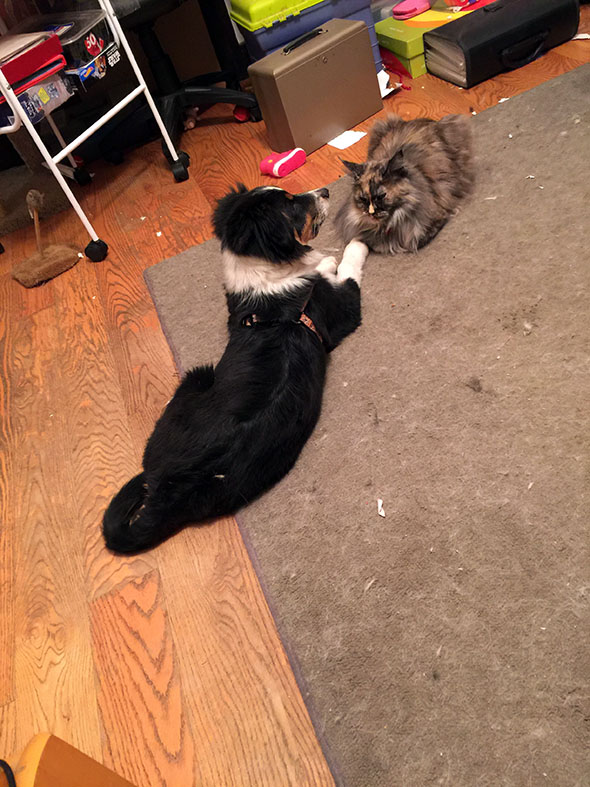
Chase is an Australian shepherd, and he immediately began trying to herd us, our guests, the other dogs, the cats, and all the wild creatures in the back yard. In retrospect, we probably should have named him Behave.


The Boys Today

Simon was closing in on his first birthday when Chase made the scene, but a male Maine coon is in practical terms still a kitten at that age, so it’s accurate to say that the two boys have grown up together.


And both have grown well. Just as with Adam, Simon’s personality blossomed after his second birthday. He has become quite interactive and affectionate. Benny has undoubtedly served as a positive role model in this regard.


Also, since my surgery Simon has become very talkative. Several times a day, he’ll burst into the room and start monologizing energetically in his expressive, trilling voice.


I haven’t quite learned his vocabulary yet, but I get the impression that he’s telling me what he’s been doing since he saw me last.

"There's like a million squirrels in the back yard! Oh, and I ate a bug and a Milk-Bone."


And when I start a conversation, he will answer me. I especially love that.

"I'm fine, pal. How are you?"


Chase’s personality, on the other hand, was already in full bloom when we first met him. He is energetic, affectionate, highly interactive, and startlingly intelligent.


Everybody who knows Chase loves him. That includes all the other pets, especially Sally and Rosalie.


He and Sally love to romp and tussle together.


Rosalie will groom him just as Evangeline used to groom Travis.


Chase is a strong alpha. He considers me to be the pack leader, with himself second in command. We know this because I am the only one he consistently obeys, and the only one he does not try to herd.

Of course, Peter begs to differ regarding this pecking order, because he too is a strong alpha. But he and Chase worked this out pretty quickly, because Peter is more than twice Chase’s size, and as I said Chase is very smart. While Chase is fearless, and nearly as strong as Peter, Chase is also no fool. Besides, Peter loves Chase, and Chase loves his pack.


And Chase loves no one as much as he loves Wifey. He may not obey her much, and he may try to herd her, and he certainly loves me. Still, he is absolutely devoted to Wifey, and is with her constantly, unless he is off on some caper.


Chase is a thoroughly sweet guy, and is rarely in anything but a very sunny mood. This is true of Simon as well.


Partners in Crime

Simon and Chase have something else in common: they are both juvenile delinquents. Actually, I’ll go beyond that to say that they are kindred spirits, and fast friends.


They even play together.


But mostly, they are juvenile delinquents.


It’s not that they are bad seeds or anything like that. There’s not a molecule of malice in either of them. Let’s just say that they like to stir the pot.


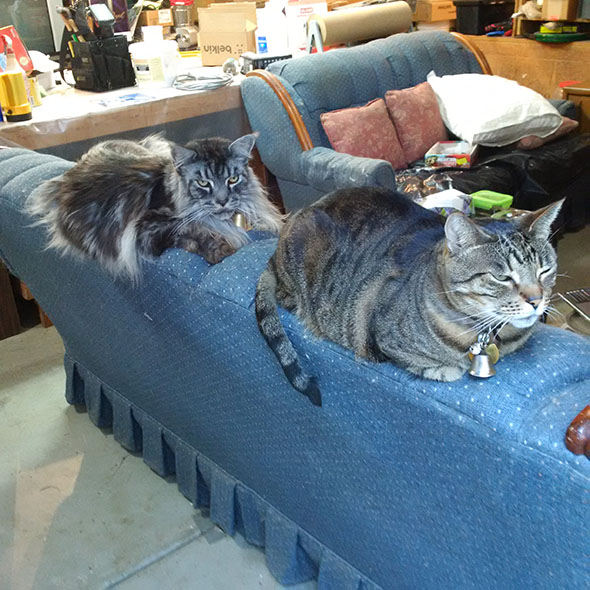
Simon, King of The Jungle, likes to monitor his domain from on high.


As a result, there is quite literally no horizontal surface anywhere in the house that he can’t get to, no matter how inaccessible it may seem.

"Nobody here but us audio-animatronic stuffed animals."


And if there’s no room for him, then he makes room.

"You'll find your Simple Green on the floor behind the dryer."


This is where Chase enters the picture. He is a firm believer in the old aphorism: “If it’s on the ground, it belongs to the hound.” Yes, I know he’s not a hound, but don’t tell him that. He’s definitely in touch with his inner Travis. Anything that Simon knocks down, Chase claims as his by natural right.

When this behavior first appeared, the typical scenario was as follows: Wifey and I are in the den, relaxing and watching TV after dinner. A quorum of the pack is in the room with us. Chase trots in, his head held high, with something in his mouth. That something is some cherished keepsake of Wifey’s.

Wifey sees this. She jumps up and starts chasing Chase throughout the house, saying “Chase! Drop it now!” in a stern voice. Chase thinks this is great sport, and fails to comply. Eventually, Wifey gives up, and makes the proffer of a treat. Chase drops the cherished contraband to take the treat. Wifey recovers the contraband.

This was obviously something that we had to put a stop to, so Wifey and I formulated a plan. First, I became the one who would engage Chase when he brought something in, because me he will obey; I would follow him through the house, closing doors as I went, until he was cornered and had to relinquish the item. Then, I would praise him, pet him, and walk away. No punishment, and no treat.

Second, Wifey did what she could to Simon-proof the house, moving all her tchotchkes, gewgaws and other assorted knick-knacks to safety behind closed doors.

Sounds like a good, sensible plan, doesn’t it? Well, sure it was. And it worked perfectly—for a few weeks. Then, one evening Chase came into the den carrying one of Wifey’s best athletic shoes, and just stood there in front of her. When she reached to take it out of his mouth, Chase backed up just out of her reach. When she then got up to get closer to him, Chase turned around and trotted to the kitchen. When we got there, we found him standing in front of the treat jar on the counter.

I looked at Wifey and said to her, “You truly are a gifted dog trainer. You’ve actually taught him the fundamentals of a barter economy!” Chase had learned that items Wifey values could be traded for items he values. When his initial source dried up, he simply found another. I told you he’s smart!


And just in case you don’t think Simon was in on this, wait until you hear about their latest caper, which happened just last week.

Wifey was preparing dinner, and had left some asparagus spears draining in a colander over the sink while she fried up some salmon filets (I’m on a strict diet right now). She looked down, and saw Chase munching on an asparagus spear; she figured she must have dropped one inadvertently.

A minute or so later, she turned to retrieve the asparagus from the sink, and saw Simon standing over the colander. He grabbed an asparagus spear and tossed it to Chase, who was waiting below.

I told you Simon has partially-opposable thumbs!


* * *

Road trip!

Monday, March 25, 2019

While I Was Out

When I learned of my heart condition fifteen months ago, my perspective on life contracted to the point where it only took in the present moment and my next doctor’s appointment. When that happened, I found it very difficult to write, although I certainly tried.

Now that I am on my way back to the land of the living, my perspective is slowly returning to normal, and the experience is quite remarkable. It feels as if I’ve been sleepwalking for the past year or so, and am now just waking up. That may be a trite way to put it, but it does have the virtue of being entirely accurate.

Here’s one example of what’s been happening in my brain: one day a few weeks ago, I walked into my study, looked around, and said to myself, “Gee, I haven’t straightened up in here for a while.” I suddenly took note of the fact that every horizontal surface, including the floor, was piled high with randomly-distributed miscellaneous items. I could hardly make my way into the room.

I consulted my renascent memory, and determined by the stratification of the piles that I had abandoned the room sometime during last July. I immediately began to put things in order, and in the process found a great many important items that had been missing for months, such as my checkbook.

That’s how it’s been for me the past several weeks. My world has come back into focus, allowing me at last to see just how deep a hole I am in after my long hibernation. I’ve begun to catch up on the most pressing of my long-disregarded chores, and have been conducting triage on the rest of them.

In this process, it has dawned on me that I need to bring you all up to date regarding all the positive changes that have occurred at the Farm House, and elsewhere in our domain, during the past two-and-a-half years. I can’t really begin posting in earnest about current events until I do this.

And so I shall, with the next several posts.

* * *

"Don't forget about me."

Tuesday, February 26, 2019

A Little Beef

My recovery proceeds apace. For a long time after I last posted, I continued to feel lousy and look worse, although it was evident from the data collected by my Two-Way Wrist Radio And Secret Message Decoder that my health was steadily improving. Over the course of January, the improvement became evident in my appearance, and by the start of February I was looking quite like my old self again.

At that time, I had my yearly physical, in which my improved state of health was enthusiastically confirmed by my doctor. This good news so buoyed my spirits that I was finally convinced to go ahead and start feeling better as well.

In general, I seem now to be reverting to my pre-2012 state, which is only fitting, considering that in retrospect, early 2012 is when my Check Engine light came on. My energy, stamina, gait, balance and general joie de vivre are all returning to where they were in the early, busy days of this blog.

Nevertheless, it must be said that my heart remains a bit skeptical of all this good news, a situation that was entirely expected at this stage of my recovery. After all those years of having to pump so hard to keep things moving through my ever-narrowing aortic valve, I still have some mileage to accrue before that Check Engine light goes out.

Never fear: this will happen in due course. But in the meantime, a few temporary conditions have arisen. One of them is that my skin has become very dry, especially on my arms and legs. Wifey, ever attentive to my condition, noticed this, and so one day recently she sat me down and told me the sobering news that I would have to give some thought to moisturizing.

Now, let it be said that I do try to keep my male ego on its range, and I think I do a pretty good job of it most of the time. At this point in our marriage, I’m a pretty domesticated fellow.

Still, I do like to maintain a respectable level of manly manliness, and let’s face it: your average manly man hates fussing with himself. A shower, a shave and an occasional haircut is all the self-maintenance he wants to deal with on a regular basis.

The idea of having to slather myself with goo all the time is galling. Not only would the added maintenance be highly annoying, it would also be embarrassing. I mean, guys aren’t supposed to concern themselves with such matters. It just isn’t manly.

All this notwithstanding, still something had to be done, and so when Wifey kindly suggested the compromise of at least trying a moisturizing body wash, I swallowed my manly pride good and hard and agreed to it, on the condition that it did not leave me smelling like a bordello.

That very day, Wifey got for me a moisturizing body wash calculated to accommodate the most fragile male psyche. I approached it as if it were potentially radioactive. I opened the bottle and gave it a tentative sniff; it smelled vaguely like meat.

Intrigued, I took a heartier sniff. Indeed, it did smell like meat—specifically, creamed chipped beef. It even smelled vaguely salty.

Now utterly baffled, I squeezed some out on my hand to get a good look at it. It in fact looked like creamed chipped beef goo, a milky gray.

So instead of smelling like a bordello, I would be smelling like the kind of diner that sports a red neon sign reading, “EAT.” If they were going to make it smell like meat, I’d rather it have been a nice medium-rare char-broiled Porterhouse steak, not bad diner food. Sure, it would be weird, but at least it would be manly. Creamed chipped beef, not so much.

But I’d gone too far to turn back, so I grudgingly started to use it, and although I don’t find the residue it leaves particularly pleasant, I must admit that it has largely dispatched my dry-skin problem, thus allowing me to avoid the disagreeable step of using a <shudder> body lotion.

And Wifey swears it leaves no lingering fragrance. I’ll take her word for it, although I’ve noticed that all the pets have become noticeably more affectionate lately.

* * *

"Mmm . . . beefy!"

Tuesday, September 4, 2018

Reboot

If you inspect the blog archive listed along the left-hand column, you will note that I started with great energy, posting 70 entries in 2011, most of them related to my work on the Farm House. My output plunged in 2012, because of a creeping lack of energy, and occasional balance issues. I was under a doctor's care throughout this period, but they reported my health as excellent. I thus pushed onward.

A crippling right-shoulder tendinitis, brought on by hanging by my left hand from the peak of the north front dormer to work with my right hand on the part I couldn't reach standing on the scaffold, shut me down completely for most of 2013. I rallied somewhat in 2014, but never really got back up to speed; my last work-related post was in March 2016.

Don't worry: all this navel-gazing has a point.

I struggled to get back on the horse until the end of 2017, when Wifey found a new family doctor. I was skeptical at first. Frankly, I was tired of hearing that nothing was wrong with me, and had been made positively gun-shy by a succession of rude doctors with dehumanizing front offices.

Wifey's report of her first visit to this new doctor indicated strongly to me that she was worth taking a flyer on, and so the week after Thanksgiving I had my first appointment with her. We had a delightful visit, and as she proceeded through her examination, she became increasingly pleased by the state of my health.

Then she said, "Well, we're almost done here. Let me just take a listen to your heart." She did so, then said, "Hmm. . . I'm hearing quite a murmur here. Do you know what a heart murmur is?" I said I'd heard of it, but didn't know what caused it. She put her stethoscope on me and had me listen to her heart: "bump-bump, bump-bump."

Then she had me listen to my heart: "bump-FWOOMPH, bump-FWOOMPH."

She told me that she thought I had a bicuspid aortic valve, and subsequent testing confirmed that diagnosis. Briefly, this means that I was born with only two leaflets in my heart's aortic valve; the factory standard is three. It's the most common form of heart disease present at birth, and it affects about 1.3% of adults. It typically doesn't start to make itself known until one's fifties.

After the diagnosis, our efforts turned towards a fix. Traditionally, heart-valve replacement has involved open-heart surgery, but recently alternate options have become available. We spent a great deal of time trying to qualify for a study of a minimally-invasive procedure known as TAVR, where they access the heart through one's groin. It's a lot safer than open-heart surgery and the recovery time is considerably shorter; our doctor was extremely enthusiastic about it and the study's lead doctor, one of the two leading cardiothoracic surgeons hereabouts.

Well, after a lot of testing, and months of waiting with no news, it finally came down that I was rejected for the TAVR study, even though my age and my complete lack of other heart or vascular disease supposedly made me a good candidate. The study doctors provided no reason for my rejection.

So, I resigned myself to the necessity of having an open-heart procedure. This was made much easier by the realization that the TAVR procedure does come with its own risks. I decided that, given my otherwise excellent cardiovascular health, the traditional procedure would give me a greater chance of unconditional recovery.

And so, we investigated the possibility of getting in with the other leading cardiothoracic surgeon in town. That proved, blessedly, to be no problem. We had actually received several personal recommendations for this doctor from former patients, but our family doctor was more enthusiastic about the other one.

This angel of healing looked over all my health records and test results, in conference with his staff, then came into my exam room and said, "How would you feel about a new minimally-invasive procedure where we go in through a relatively short incision on your upper chest to do the work?"

Uh, how do I feel about a miracle? The most munificent answer to a prayer I have ever received? "Yes, that'd be great!" I exploded as calmly as possible (I had learned by that point that I needed to stay calm at all times, in order to keep my pulse below three digits).

Cutting to the present, the operation was last Tuesday. It took a snappy hour and forty-five minutes for my doctor and his associates to bring me up to design specs. I came home on Saturday, after a surprisingly enjoyable hospital stay. Without exception, every doctor, nurse and technician with whom I came in contact treated me with a friendly respect. That is a huge understatement, but it is at least accurate; all seemed to enjoy their job greatly, and showed genuine personal interest in my recovery.

Moreover, I was deeply moved by the attention and concern shown, and help rendered, by my family and friends. I sincerely did not know that I mattered so much in this world. I thank you, Wifey thanks you, and our pets thank you.

I have about a month of closely-monitored recovery in front of me, but even under the dizzying influence of a dozen medicines, I feel much better than I did before the operation.

So soon after my recovery is complete, I hope to debut Otis 2.0: now with increased oxygen content!

And I did eventually learn why I was rejected for the TAVR procedure: my aorta is bigger than their biggest artificial valve! I thus have documentary proof of what I've been saying all along: I'm a big-hearted fellow.

* * *

"Where were you?"

Wednesday, November 29, 2017

Death Valley Weekend

Here I am once again, apologizing for the long drought of posts. Rest assured, I have several posts in the pipeline, one of them nearly complete. I have however been distracted from writing by a cascading series of computer disasters that at last culminated in my purchasing of a big new tower computer and its provisioning with a dozen terabytes of storage.

Since then, my time has largely been occupied by the re-assembly of my computing domain, jigsaw-puzzle fashion, from my many far-flung backup locations. In the process, I came upon a treasure-trove of articles from my early days as a writer, when I was doing pretty much nothing but writing whatever was on my mind.

Of course, a writer tends to look upon things he wrote over two decades ago with a certain affectionate loathing, and most of the articles, if they ever see the light of day, will require extensive re-working. But I did find one article that, to my great surprise, is ready to go. It is a narrative of a Memorial Day weekend Wifey and I spent with our good friends, then as now, Nik and Jo. Wifey and I have determined that this occurred in 1995.

It occurred to me that the article would serve as a nice proffer to my blog readers of my intention to return soon to active posting. And so, with Nik and Jo's kind consent, I offer it forthwith, with no changes other than the deletion of a few references to then-current, now-obscure events, the explanation of which would be too painfully laborious to read (and write). This piece is already plenty long. Other than that, I have changed nothing, and you will no doubt notice that back then I used commas as if they cost a quarter each.

There is one obscure reference I did not delete, because it's an integral part of the story: “hell-architecture.” This refers to a place in Montrose that I lived in for several years in the early Eighties that was known among my circle as “Hell House.”

When I took the place over from my good pal—let's call him Lou—who had lived there for several years, it was already legendary for its many distinctive features. I could write an entire post about Hell House, and someday maybe I will, but for the sake of this story you only need to know a few essential facts.

Hell House seemed to have a will of its own. For example, the place was as hot and stuffy as Death Valley itself when it was hot outside, and cold and drafty as the North Pole when it was cold outside. Clearly, the place knew what conditions were the most uncomfortable at any given time, and made adjustments accordingly.

Another curious feature was the many items attached to its walls, the function of which defied explanation. Mostly, these took the general form of randomly-shaped pieces of wood, sometimes stacked upon one another, often with strange pieces of handmade hardware attached. None of us could ever imagine any possible utility any of these items might once have had. We eventually concluded that they were artifacts of some obscure pre-Columbian religion.

Thus, hell-architecture, as I use it in the following, means “a structure that shows evidence of Hell House-like qualities or features.”

Thus fortified, you are now prepared to move forward into the past.

* * *

Nik and Jo like to go camping in Death Valley. Nik loves what he calls its “moonscapes devoid of vegetation,” and has utilized them several times as striking backgrounds for his photographs. Jo, I think, simply enjoys meeting the challenge of camping in style.

Some time ago, Nik and Jo invited Lydia and me to accompany them on a Memorial Day weekend trip there. When Lydia and I agreed, he immediately and with great enthusiasm began to plan the trip. He graciously took care of all the details, including the all-important morning coffee. Virtually all Lydia and I had to do is show up.

At last getaway Friday came. Nik and Jo left very early in order to secure two prime campsites. The plan was for us to come a few hours later; Nik would call us from the campground on our cellular phone en route to give us the exact location.

Unfortunately, Lydia had some last-minute business to attend to, so when Nik’s call came we were still home at the Doll House. We loaded up the car and set out at 2 P.M. We hit a traffic jam in Montebello that did not dissipate until Barstow.

We pulled into the campground in a somewhat crazed state at about 10 P.M. I was afraid Nik and Jo would already be asleep. Not only were they still awake, but Jo had an excellent dinner of game hen and grilled vegetables waiting for us. After Nik helped me set up our tent, we dined in style.

The next day dawned overcast and muggy. It took four pots of Nik’s strong but excellent coffee to revive us. We spent the day exploring the valley floor. Death Valley, like all of California, saw record rainfall this past winter, so Nik’s beloved moonscapes were uncharacteristically scarred with vegetation.

We drove by a marvelous old huge stone lodge called the Furnace Creek Inn. Nik suggested we give it a look-see later in the day, but I noticed as we passed a sign saying “Closed for the Season.” I asked Jo whether there really were seasons in Death Valley; she replied that there were but two: Too Cold and Too Hot.

We drove first to Dante’s View, which overlooks a massive salt flat called Badwater. Looking down at the view, I began to understand what Nik had been talking about: the place was perhaps a bit more colorful than the Moon, but it certainly did not look like a Class M planet. The only things marring the effect were occasional clumps of beautiful little desert wildflowers, which seemed to annoy Nik with their presence.

We then descended down to Badwater itself, which at its lowest is 282 feet below sea level—the lowest point in the United States. The place was very crowded. Oddly enough, most of the people seemed to be German. We walked out on the salt flats themselves, which were still moist from the winter rains.

To my great horror, Lydia picked up a bit of the well-trampled, dirty white earth and tasted it. “Hey, this really is salt!” she declared triumphantly.

I snapped, “Great! Now you have Teutonic hoof-and-mouth disease!”

“But I walked all the way out here to a clean area!” Lydia protested.

Nik grinned. “Now, Rob, Lydia was merely conducting a scientific experiment.”

Jo added, “Yeah—taste is a perfectly valid way to assess the composition of something.”

Alone among the sane, I remained unconvinced. “Well, I still think that you’d better gargle with some Liebfraumilch later.”

We then drove to the Devil’s Golf Course, a part of Badwater so named because gases rising from below the salt cause little spherical formations that resemble golf balls. Unfortunately, the winter rains had destroyed this effect, and the place looked more like the Devil’s Sand Trap.

As we drove away, it began to drizzle, which Nik said was a fairly rare occurrence on the valley floor. Lydia was unimpressed nonetheless; she said that it always rains when she goes to the golf course.

We next visited Artist’s Palette, which is aptly named. It consists of a small outcropping of hills forming a natural amphitheater, featuring scattered patches of muted pink, blue, green, yellow and purple earth. It looked like a giant chalk painting funded by the National Endowment for the Arts.

After this was Zabriskie Point, which is supposed to be of great interest but was to me quite unremarkable. From it, one looks out upon a tiny valley-ette, perhaps a tenth of a mile across at its widest, which looked to me like a Caltrans excavation minus the lounging workers.

At this point we headed back to camp for lunch. We returned to find ourselves surrounded by even more Germans. It was quite astonishing to us that so many of them had traveled so far to camp in such an inhospitable place. After some discussion, we concluded that it is wise to view bargain package tours with circumspection.

After lunch, we were all in need of a good lie-down. Bouncing along dirt roads in muggy 92-degree air had taken its toll. Fortunately, the sky cleared in the late afternoon, and we spent a pleasant evening star-gazing through Nik’s powerful yet compact new telescope.

The next day dawned clear and very hot, so we decided to leave the valley floor and explore the higher (and cooler) elevations. As the mercury rose to an eventual 110 degrees at our campsite, our intrepid guide Nik pointed his trusty Tracker south to gold-mine country.

As we left, we stopped off at the Furnace Creek Resort, a small concession area that has guest bungalows, a golf course, a store, two restaurants and a saloon. Lydia and I took particular note of this last item.

On our way southward, we passed through the Devil’s Cornfield, so named because the creosote bushes there had arranged themselves in a remarkably even-spaced configuration that resembled rows of hellish corn. Nik commented, “You'll find that the Devil owns a lot of real estate here.”

After a time, we left the glass-smooth surface of California 190 for a rude dirt road. Its washboard surface was pitched at just the right frequency to induce harmonic resonance in the Tracker’s chassis. We hummed along like a 64-foot organ pipe for about nine miles until we reached the site of Skiddoo, a gold-mining town that existed from about 1907 to 1915, then disappeared without a trace.

Once there, we stopped to stretch our legs. It was oddly beautiful up there. Nik was right when he said that this was a desert unlike any other. The sky was a clear, deep blue, the temperature was in the mid-70s, and everywhere one looked there were clumps of charmingly beautiful little wildflowers, some of which are evidently found only in Death Valley. It was astonishing to see vibrant orange poppies and pastel-hued daisies springing from otherwise barren earth. Lydia found this an image heavy with meaning.

Nik had brought along a book on ghost towns, and as we took in the spectacle he read us the story of Skiddoo. After he was done, I looked at the book, and read that a few miles further on stood the remains of the Skiddoo stamping mill. I was surprised, considering how assiduously the Forest Service had demolished all such structures in the Angeles National Forest.

Evidently the National Park Service is less concerned than the Forest Service about idiots hurting themselves, because there the mill stood, just as the book said, a few miles further on. It had deteriorated noticeably from when the picture in the book was taken, but it was still spectacular: well over 100 feet long, it was composed of several levels built down a steep incline.

It reminded me of one of those cable cars that used to ascend the incline to Echo Mountain House above Pasadena, except that it was fifty times bigger. There were obvious signs of a recently-begun trussing of the structure, but otherwise the site looked as if it had lain untouched for the eighty years since its last use.

It seemed as if the workers had simply laid down their tools, walked away, and forgotten all about the place. There were implements, now nothing more than lumps of rust suggesting their former shape, strewn all about. An ore car still rested on its tracks, awaiting its next load. Towering above everything, the four stamping mills stood in a row, silhouetted by the sun, still seemingly complete.

The fact that all this had remained evidently unvandalized for so many years by all but Mother Nature improved my assessment of human nature just a bit.

Curious as to what other treasures these mountains held, I picked up the book again. I saw that a few miles further up the paved road was another dirt road leading to another collection of promising sites, all bearing the rather odd name of Aguereberry. We went to investigate.

I will omit much of the historical detail for brevity’s sake, but perhaps a little background is in order here. Aguereberry was a Basque who came to Death Valley in search of gold. He found it—or so he thought: a vein that initially assayed out very promisingly. As it turned out, there was little actual gold in his claim.

Nonetheless, after securing sole rights he began to mine the vein in earnest, establishing a little compound nearby. His best efforts yielded scarcely enough gold to live on, so to augment his income he hired himself out to tourists as a guide. To provide an attraction, he graded and paved a road up to a mountaintop from which one could take in a view of much of the valley and the surrounding mountains.

We hummed up that road, long since stripped of its pavement, and took in Aguereberry Point. It was a restful place, miles away from the nearest German. In fact, the only other person up there was an aging hippie sitting on a rock in front of a view camera. His hardy Bug, which I reckoned he had owned since his youth, stood faithfully nearby. I anticipated that the presence of a fellow large-format photographer would pique Nik’s interest, but he quickly walked off in another direction.

I expect this was because the fellow’s appearance was rather off-putting. He was shirtless, and his skin, tanned cancerously dark, draped over his midriff like a leather muu-muu. He was otherwise quite inoffensive, however; spying my Angels cap, he initiated a friendly chat about their performance and prospects this season.

After this fellow and I had managed the Halos to a pennant, Lydia and I hiked up to the very top of the mountain. Badwater lay 7000 feet below us, and Mt. Whitney stood over on the horizon. I realized suddenly that our gaze was taking in the lowest and highest spots in the continental U. S. simultaneously.

Again, wildflowers were everywhere, and we became quite enchanted with one species that sported a plume of cheerful scarlet flowers. Subsequent investigation revealed the name of this plant to be “Indian Paintbrush.” Sadly, Home Depot does not stock these seeds.

We drove back down to Aguereberry’s mine, expecting to find more ruins. These we found, similar to but less elaborate than those at Skiddoo. There were more rusted remains of tools, and an ore-crusher built down the side of a hill in a similar fashion to the Skiddoo stamping mill.

What we didn't expect was to find that we were able to enter the mine itself. Generally these are fenced off and forbidden, but evidently this mine was judged to be safe to explore. There was a plaque at the entrance explaining that the mine served as a hibernation spot for some endangered species of bat, and that they did not take kindly to being disturbed.

The feeling was mutual, so I was glad it was almost Summer, and the little disease-carriers were out frolicking elsewhere. The plaque also warned against entering the mine without a good light-source. Fortunately, we had brought along a lantern, and so we went in to investigate: single-file, Nik in the front with the lantern, I in the back banging my head on the ceiling. “I hope no one here is claustrophobic,” Nik said cheerfully.

The tunnel branched off after a short distance, and at the fork rose a chute, evidently used to haul ore to the crusher directly above us. The air was cool and surprisingly fresh. We were able to go in about a tenth of a mile before the inevitable fence prohibited further progress. I had never seen the inside of a real mine before, and it was impressive to see how surgically Aguereberry had cut his passageway. It’s amazing what one man and some dynamite can do.

We then made our way around to Aguereberry’s little compound. This consisted of three buildings assembled around a fire ring. The center building had been the residence; to one side was a galley, to the other a supply shed. Again, it was fascinating to see how unmolested these buildings were. The galley still had its refrigerator and a full-size kitchen stove (made by Coleman, just like Nik’s camp stove) that ran on gasoline.

The residence was hell-architecture at its most assertive. How else could it have stood for so many years in this hellish place? It did have indoor plumbing after a fashion, but as there was also an outhouse out back, I assume the toilet was a later improvement. The wiring, all external, probably was also.

The most telling hell-feature was the presence of a number of mysterious wooden appurtenances nailed to the walls. I wonder if Aguereberry’s travels ever took him through Montrose? What a cool bachelor pad the place must have been in its heyday.

With time now pressing, we made our way hastily around the rim of the valley to Scotty’s Castle, near the Nevada border.

Death Valley Scotty was a yarn-spinner and small-time con artist, just one of the many odd creatures an odd place like Death Valley naturally attracts. His one honest asset was an encyclopedic knowledge of Valley topography, which he used to spin a convincing tale of a “secret gold mine,” the location of which was known among the living only to him. This story managed to hook a big fish from the Midwest: Albert Johnson, an insurance tycoon looking for a good speculative investment.

Johnson was no fool, and he soon spotted Scotty for the charismatic huckster he was. He and his wife were nonetheless quite charmed by Scotty, and the three soon became fast friends. The Johnsons were also charmed by the Valley itself, and decided to build a vacation home there.

Scotty found them a prime location in Grapevine Canyon, which among other attributes contained a spring providing ample water for the elaborate compound they quickly began to construct, a compound complete with a power-generating water wheel, huge solar water heater, and even a clock tower.

Eager to avoid the scrutiny of a public naturally curious to see such a prodigious effort underway in this remote location, they used their friend Scotty as an able front man, encouraging him to represent himself as the owner of the spread. Scotty had finally found how to make an honest living out of dishonesty.

Mrs. Johnson was a devout Christian of a Protestant evangelical sect, and when the Depression hit, the Johnsons ceased construction, by then only about 85 per cent complete, in order to use their funds to help the needy.

The three of them lived out the rest of their days in this unfinished oasis, which when they passed was bequeathed to their church. This church conducted tours of the estate to raise money for their missionary efforts for over twenty years, finally cashing out to the National Park Service in 1970.

While it was fascinating to see how ingeniously Johnson’s architects had met the challenge of building a palatial estate in such a hostile environment, I found myself becoming increasingly saddened by the significant deterioration the Feds had obviously allowed to occur.

By then evening was approaching, and we decided to brave a return to the valley floor. It was still devilishly hot, however; despite the best efforts of the Tracker’s air conditioning, we could feel the temperature rise uncomfortably as we descended. Lydia, quick on her feet as always, suggested we take refuge for a while in the air-conditioned comfort of the saloon we had seen that morning.

At this point in my story I am reminded of a line from the John Wayne film Angel and the Badman: a doctor, ruminating on the inherent limitations of the physician’s craft, says to the Duke: “It’s amazing, the varied uses to which men put alcohol. To each different individual, it’s either a stimulant, a depressant or an anodyne. Just now, I’m using it as an anodyne.”

Just then, we four were in grave need of an anodyne ourselves. Nik and Jo had gone to great lengths to ensure us of an enjoyable stay in the Valley, and while they had been enormously successful at this, still we were hard pressed so to convince them. After all, Death Valley is widely known as one of the harshest environments on Earth, and a weekend of exposure to it had rather blunted our social skills.

Even Nik and Jo, experienced Valley-dwellers as they were, had felt the effects of what Nik called afterwards “the hottest weather I have ever experienced.” A round of frosty Margaritas, silly but festive, was under these conditions exactly what the doctor ordered.

Our spirits (if not our bodies) restored, we chatted amiably while munching the complimentary popcorn and watching the Dodgers drop another one to the Phillies. At last Lydia and I were able to show our gracious hosts that we were indeed enjoying the Death Valley experience.

After yet another fabulous dinner, as we relaxed in the relative cool of the evening, Lydia remarked: “You know, I feel like heck, but I feel great.” I felt this to be a remarkably apt description of the camping experience in general.


Dawn came especially early and hot, and we quickly struck camp so that we could skedaddle before our brains shut down entirely from the heat. After bidding farewell to Nik and Jo, we departed.

Unwilling to face another Brobdingnagian traffic jam, we left Interstate 15 at the first Barstow exit in order to pick up old U. S. 66. This turned out to be fortunate timing on our part, for as we looked back at the freeway we had just left, we saw cars at a standstill approaching the junction with I-40. There but for the grace of God… .

We stopped at the Barstow Bun Boy for a delicious repast, then continued along old Route 66 through Victorville, eventually joining up with the Pearblossom Highway. We had originally planned to take Angeles Forest Highway, but on a whim I turned early and headed almost straight up the mountain to Big Pines, in the heart of the Angeles National Forest.

Up there in the cool fragrant mountain air, surrounded by tall pine trees, our spirits soared. Now that the ski runs had closed for the season, we had the place to ourselves. Under the command of yet another whim, we parked the car and took a walk among the trees.

We realized that, fascinating as Death Valley was, it was here in the forest that we felt truly elevated. Invigorated, we returned to the car and followed Angeles Crest Highway down into the smoke and haze of civilization.

The first thing an Angeleno does upon returning to the city is turn on the radio to catch the traffic report. It is a time-honored rite of re-entry. The big news was a miles-long traffic jam on the south I-15 stretching from the I-40 junction to San Bernardino. It’s so nice to go trav’ling, but it’s oh so nice to come home.


Looking back on the experience, it occurs to me how lucky we are to live in California. I have lived here all my life, and still the state continues to surprise and delight me with its seemingly endless scenic variety. Within striking distance, we have inviting beaches, rugged mountains, fertile farmland, and—Death Valley.

Surely Death Valley is unlike any other place on Earth. There one may see Mother Nature at her least accommodating. Parts of it are not just uninhabitable, but positively malevolent: one way or another, it is always trying to kill you.

And yet, I find myself oddly attracted to the place: if you can survive it, it rewards you by expanding your understanding of what is beautiful. My mind keeps returning to the image of the beautiful little poppy poking defiantly out of the gray earth. It seems Lydia saw immediately what occurs to me only now: even when life seems quite barren, still there is hope that good may spring forth.

But let’s not forget about the malevolence. Camping in Death Valley is not for the faint of heart, which is why I’m glad Lydia and I had Nik and Jo with us. Not only are they able campers, but good companions as well, with a gracious sense of humor that helped us take the full force of Death Valley’s assault in stride. We look forward to camping with them again—but next time, in some more habitable spot, preferably with trees and grass and perhaps a nice stream.

As for Death Valley, I am sure we will return for further exploration, but next time we’ll stay at the Furnace Creek Inn.

* * *

Postscript: At the end of scheduled play, the Angels and Dodgers had identical 78-66 records in the strike-shortened 1995 season. That won the Dodgers their division; they went on to meet Cincinnati in the National League Divisional Series, which they lost, 0-3. 

The Angels found themselves tied with Seattle for first place, and had to play them the next day in an elimination game, which the Angels lost. 

Nik still has the Tracker, and that swell telescope.

"But we won it all in 2002."

Friday, August 25, 2017

Happy Birthday, Morning!

Today, August 25th, is an important day in Farm House history. On this day in 1865, Anne K. Johnson was born in Gloucester, Massachusetts. Of course, we know her better as Anne J. Wilson, who moved to the Farm House with her two sons in 1902, and lived here until her passing in 1969 at 104 years old.

I have a great deal to relate to you all. Let me give you a small preview by telling you that one of Anne's grandsons, Christian Gerard, visited some time back with his family. It was a red-letter day for the Farm House, and I promise to tell you all about it when I get my notes together. But let me give you one tid-bit right now.

Christian, whose family lived in the bay area, visited here one day in 1955, en route with his family to a new local attraction, Disneyland. He tells me that the family knew Anne as "Morning."

So Happy Birthday, Morning! It is very nice to get to know you better.

Friday, January 6, 2017

We Are One Fewer

I apologize for the long season of sadness in these pages.

In this new year, I would like to go forward in a more cheerful frame of mind. I do have a few happy things to report that I have held in abeyance for several months, simply because one of the happy things has taken up the majority of my time.

But before we move forward, I am sorry to have to tell you all that I have more sad news.

I am grieved to report that our beloved Travis has passed away. He was eleven years old. He was truly the straw that stirred the drink here at the Farm House, and as such, his absence is felt palpably--keenly--by all of us, every waking hour. Everyone loved Travis.

I will write more about Travis later.

Travis
August 12, 2005–December 18, 2016

Wednesday, September 28, 2016

Adam, My Star

I realize that most of my subject matter in these pages is terribly dry and prosaic. It consists, after all, mostly of matters such as digging holes and patching wood. These are not things that readily stir the heart or fire the imagination.

I of course do my best to present this subject matter in an entertaining way, but even the most adroit wordsmithing can only go so far towards making silk purses out of these sow's ears.

And so, to bridge the remaining gulf between informative and entertaining, I have long relied upon our Pet Division. I'm always snapping pictures of our dogs and cats, and very early in the blog's history I started trying to work them into my posts as a way to provide some visual relief.

The pet I have most relied upon for this function is Adam. This has not been a matter of favoritism, really; it's just a practical result of his having been my constant companion (with time out for litter box breaks, of course), combined with my always having a camera on my hip or within reach. Well, one must also consider his wild good looks and expressive face. 

Let's face it: the camera loved Adam. Adam was the star of this blog.

With your kind indulgence, I'd like this post to serve as a commemoration of Adam's significant contribution to these pages, and also, for the time being, as a token of his significant contribution to my life.

Adam's first appearance was actually in a video, a wrasslin' match with Benny shot when he was nine months old: "It's Movie Night!" Adam and Benny's fights were always quite entertaining and often quite epic.

Adam's first photographic appearance in these pages was on May 8, 2011, in the post "Better Living in Two Parts, Part Two."


I was describing how before I got to work on the house that morning, I brought Adam, Benny and Travis out to get some sun; I included a photograph of each to illuminate the text. It's one of my favorite pictures of him, because it looks for all the world as if a small wild lynx had somehow wandered into the back yard looking for prey.

It not only captures his relentlessly inquisitive nature, but also his impressive stature. Adam was a long cat: nearly 45 inches from the tip of his nose to the end of his tail, once he finished growing. They simply don't come much longer than that. In point of fact, the Guinness Book of World Records Longest Cat in The World is also a Maine coon, and he is 48 1/2 inches long. It is thus verifiably not hyperbole to say that they don't come much longer than Adam.

Adam was long, lean and stronger than most dogs three times his size, and you can see all that in this picture. And he hadn't finished growing when this picture was taken. He was only a petite 3 feet long at this point.

Adam was the subject, and the inspiration, of the first coda picture I ever posted: May 27, 2011, in the post "No Snickers, Please":

No rinsing needed.

I recall coming into the kitchen, seeing Adam sitting there looking so nonchalant, suppressing my laughter, and having the good fortune to find my camera right there on the kitchen table. The caption came to me immediately when I looked at the photo, and it occurred to me that this would be a great thing to put at the end of my next post. I was so pleased with the result that I resolved to make a concluding photo of our pets--what I now call a coda picture--a regular feature. Since then, there have been few posts without one, and it all started with Adam.

The next post, two days later, was of another Adam/Benny combat video ("Million Dollar Movie"), this time with the two battling for possession of the love seat in the den. It is one of the top four posts in the blog's history. A coda picture seemed duplicative here, so I left it out.

But I was back at it the next day ("Breezin' Along with The Breeze"):

"Nobody here but us dogs."

This shows another distinct character trait of Adam's: he was quite democratic. As long as you were of a predator species, he was willing to take you as you were. He was as likely to hang out with the dogs as with his fellow cats. As you can see in dear Nellie's face, this made the dogs a bit uneasy at first, but they tolerated it, and in time became comfortable with it. Nowadays, our dogs and cats form a unified pack and mingle comfortably, although Adam's little cousin Rosalie is the only one who actually will cuddle up with the dogs. Perhaps it's a Maine coon thing.

I have a great number of photos with Adam hanging out with the dogs, but only two others made it into these pages. Here's the next one:

Absit invidia.
(from "A Posse Ad Esse", 7-20-11)

Adam has made himself so completely at home that he is grooming himself, and practically leaning on Travis while he does it. Travis' "what the---?" expression bespeaks an offended sense of propriety, but it's really just a karmic payback, because as a puppy he did the same thing to our first Maine coon, dear Roger:


Judging from the look on Roger's face, his forbearance here in not smiting Travis on the sconce is masterful.

I should explain all the Latin I'm throwing around here. Absit invidia means "let there be no ill will;" it's a phrase that is customarily used, similarly to "no offense intended," to smooth over small offenses before they become big ones. The phrase in the post title, A posse ad esse, translates most accurately (I think) as "from potentiality to actuality," but I like to translate it in this case as "I finally figured out how to do it, so I done went and did it." The post was a review of several difficult tasks that I had somehow managed to complete successfully. The Latin title induced me to provide Latin captions for each photo, and I naturally carried that theme through to the coda picture.

Here's the third Adam + Dog coda picture, again with Travis, who's a pretty photogenic fellow himself:

"You missed a spot."
(from "Reunion", 11-9-11)

Travis' unruffled "really, dude?" expression here reflects his and Nellie's gradual acceptance of the fact of Adam's frequent propinquity.

As I said, Adam was just as likely to hang out with his fellow felines:

Must be dinnertime.
(from "Unpacking A Mess", 6-19-12)

Oh, look! There's our dear CEO Emeritus, Evangeline! She and Adam had a sweet mother-son relationship.

"Kenneth, what is the frequency?"
(from "A Rather Irksome Revelation", 9-18-11)

"Our minds are one: I feel what you feel; I know what you know."

For one who grew up watching Star Trek, the above caption wrote itself. It was during a period where Adam was putting out Trek vibes. At first he was doing Spock:

"Live long and prosper."
(from "Writing Stories", 8-29-11)

But he soon switched to doing Kirk, which I think is perfect casting:

"Khaaaaaaaaaaaaaaaannnnnnn!!!"
(from "Inch by Inch, Step by Step", 9-7-11)

One day when I was working on rehabilitating the north windows, I left one open, and soon Adam appeared, standing on the sill majestically like the Lion King looking out upon his domain. He was six and a half months old, just starting a massive growth spurt, and it was the first time I saw the bold, majestic, royal bearing that was to become his hallmark. Our little kitten was growing up. It gave me an idea, and I assembled a story arc of coda pictures that ran with the next five posts:

Space: the final frontier.
These are the voyages of the starship Enterprise. . .
. . .its ongoing mission: to explore strange new worlds. . .
. . .to seek out new life and new civilizations. . .
. . .to boldly go where no man has gone before.
(starting from "Regaining Focus", 10-22-11)

I love every picture in this sequence. The second one, with Adam and Benny on top of the cat stand, accurately captures the character of each, right down to their bling: Adam the star, of course, and always-impeccably-groomed wing man Benny with his bow tie. Benny still has his bow tie, but all the information has worn off of it. He needs new bling.

The three middle ones taken together remind me that much of the time, Adam, Benny and I were the Three Musketeers--or, perhaps more accurately, the Three Stooges. The last picture is easily the edgiest one I've posted here, but I had to use it: it fit the caption perfectly. I hasten to add that I shooed Adam down from there right after I took the picture.

* * *

Looking back reminds me how easy it was to write captions for Adam's photos: they were all dictated by the expression on his face, which always seemed to convey a distinct mood, thought or sentiment:

I. Am. Awesome.
(from "Overnight Thread", 8-6-11)

Of course, this brought an immediate rebuttal from Evangeline:

I invented awesome.
(from "Epoxy Revelations", 8-10-11)

Which begat this response from Adam:

"Thirteen pounds, nine and a half ounces of wild feline awesomeness."

Later, his niece did this homage:

"I. Am. Fabulous."
(from "Board Surfing", 8-5-12)

She has since only become more fabulous, I assure you.

More of the many moods of Adam:

"You want cute? I can do cute."
(from "Vision Quest", 10-4-11)

"Your nail set's stuck in your hair."
(from "Furnace Gap, 1943-2011", 11-17-11)

"Shouldn't there be a big pointy tree with lots of prey on it here by now?"


"Let's see. . .f/5.6 at 1/125 sec. That should work. Now where's the danged shutter button?"
(from "Rendezvous at Furnace Gap", 11-10-11)

"Words fail me."
(from "Aftermath", 12-16-11)

He who controls the remote, controls the future.
(from "Goofus And Gallant", 6-19-14)

There are some stories only cats can hear.
(from "CSI: House", 5-4-2015)

Occasionally, I was smart enough simply to allow the photograph to speak for itself.


I've been doing pretty well so far, but I have to admit that this last photo chokes me up a bit. It captures his spirit so very well: sweet, forthright, fearless.


These next two are my favorite Adam coda pictures, because each has a significant story behind it.

The wily Forest Cat returns to his lair with the day's catch.

I love this photo because some of my fondest memories of Adam involve his carrying this big dog toy throughout the house as if it were fresh-killed prey, looking for a safe place to put it. Someday I'll tell you all about this remarkable, endearing and at times hilarious aspect of Adam's character, but it's too long and involved a story for this already Brobdingnagian post.

We had a set of these dog toys, and although the crocodile was far and away his favorite, he at times used all of them as prey, as we see in the next photo:

"I bring you this offering of fresh-killed prey in token of my appreciation for your fealty."
(from "Well, How 'Bout That", 3-17-12)

Despite the slight astringency of the caption, this was quite a tender moment, one that marked a turning point in our relationship. While Adam was from the first my constant companion, up to the time of this picture (he was then a few weeks past his second birthday) he was not particularly affectionate. Not that he wasn't friendly, but he was not terribly interactive unless we were playing. He always seemed preoccupied, as if he were listening to the call of the wild.

Then one day, as I sat in the den working at my laptop, he walked in, laid his prey gently on the floor before him, then sat down and gazed at me with solemn significance for quite a long moment, just as you see above. Before this, Adam and I were packmates. From this moment on, we were soulmates. He was more engaged, more interactive, more in the moment. He became quite talkative. Most importantly, on every remaining day we had together he became more and more affectionate, and more and more happy.

I can't offer any explanation for the seemingly sudden transformation other than it was a natural part of Adam's maturation. Maine coons grow up very gradually, typically continuing to grow until they are five years old. Such was the case with Adam; his little cousin actually grew visibly after her fifth birthday. Remarkably, this last growth spurt resulted in her resembling Adam, whereas before she had no particular physical resemblance other than her markings. I can't explain that at all.

* * *

The last coda picture in which Adam appeared was posted on December 15, 2015, in the post "For the Birds, Part 1":

The Wily Forest Cat lies in wait for his prey, after having hidden all the remotes.

Adam could be found here quite regularly at this time whenever the whole pack was together in the den; he had a habit of adopting a place as his base of operations, and then sticking to it for some time. In this, he was just like Roger. In this photo, Adam is looking down at Peter, which puts me in mind of another photograph, taken the night the two met:


Adam was utterly baffled regarding what sort of creatures we had brought into the house, and he spent the next several days surveilling them until he determined at last that they were, in fact, dogs.

Adam's last appearance in these pages before his passing was in "The Big Pedagogy", just two posts ago on March 7, 2016:

Loungers lounging in the Lounge.

This represented my first attempt to bring the idea of the coda picture right smack dab into the middle of the narrative, to leaven an especially-dry subject with a little humor and a lot of personality and charm. And these are---were---my go-to guys for that.

* * *

I thank you all from the deepest part of me for your kind indulgence of my reverie.